
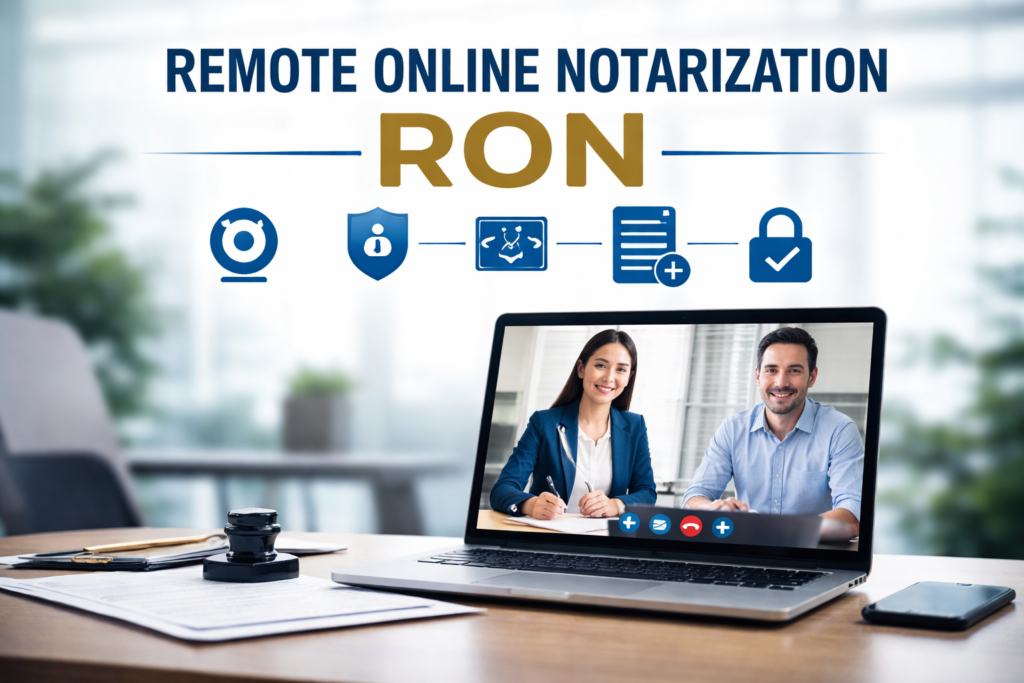
Remote Online Notarization (RON) allows New York notaries to notarize documents electronically using secure, real-time audio-visual technology. Although the process may seem complex at first, understanding the rules and tools makes RON much easier to offer with confidence.
In this guide, you will learn how RON works in New York, which platforms you can use, and how to avoid unnecessary costs when starting out.
What Is Remote Online Notarization (RON)?
First, RON allows a notary and a signer to meet remotely through a secure video connection instead of meeting in person. However, RON requires more than a simple video call.
Specifically, New York law requires notaries to use secure audio-visual communication that verifies identity, protects documents, and records the notarization session. Therefore, notaries must use specialized RON technology rather than common video apps.
What Secure Audio-Visual Communication Means
To begin with, secure audio-visual communication provides a live, two-way video and audio connection that meets legal and security standards.
More importantly, it includes:
- Encrypted video and audio connections
- Real-time identity verification
- Recorded notarization sessions
- Secure storage of documents and recordings
- Protection against document tampering
Because of these requirements, notaries cannot use Zoom, WhatsApp, FaceTime, Skype, or similar tools for RON in New York.
Does New York Require a Specific RON Platform?
Notably, New York does not require notaries to use one specific RON platform. Instead, the law focuses on compliance. As long as the technology meets New York’s legal standards, notaries may choose the platform that works best for them.
However, in practice, the platform you choose often depends on the companies or signing services you work with. For that reason, flexibility matters.
RON Platforms vs. Signing Services
At this point, it is important to understand the difference:
- RON platforms provide the technology used to perform remote notarizations
- Signing services assign work and may require you to use specific platforms
In other words, signing services do not perform notarizations themselves. Instead, they tell you which platform to use for a particular assignment.
Proof (Formerly Notarize) and Platform-Specific Training
One platform many notaries start with is Proof (formerly Notarize), especially because it offers free platform training.
After completing Proof’s training, you receive the Notarize Network Platform Training (NST) New York Certification. This certification confirms that you know how to use the Proof platform in compliance with New York RON requirements.
From experience, some signing platforms—such as Snapdocs—ask for proof of RON training from approved providers, including Proof, NotaryCam, or Pavaso. In those cases, Proof’s NST certification helps meet that requirement.
Choosing a RON Platform Strategically
At the beginning of your notary journey, strategy matters. Instead of registering with multiple paid platforms right away, it makes more sense to:
- Start with a free or affordable platform
- Learn how RON works in real assignments
- Add other platforms only when a company requires them
In short, there is no reason to spend money on platforms you may not use—especially early in your business.
Digital Certificates and RON Platforms (Very Important)
Now, let’s talk about digital certificates, which often cause confusion.
Most RON platforms require a digital certificate to perform remote notarizations. However, platforms handle certificates differently.
- Some platforms issue their own digital certificates
- At the same time, many of those platforms also accept third-party certificates, such as IdenTrust or NNA certificates
There is also a key difference in cost and renewal:
- IdenTrust certificates require annual renewal
- Some platform-issued certificates involve a one-time purchase with no renewal
Because many platforms accept IdenTrust, many notaries choose to purchase one IdenTrust certificate and upload it to multiple platforms. Although it renews yearly, this option avoids buying separate certificates for each platform.
As a result, investing once in a widely accepted certificate often saves time and money as your business grows.
Final Thoughts
In conclusion, Remote Online Notarization gives New York notaries a powerful way to expand their services. Although RON involves technology and rules, a clear understanding makes the process manageable and profitable.
By choosing compliant platforms, completing the right training, and avoiding unnecessary expenses early on, notaries can grow their RON services confidently and legally.